

Tools for Traditional Japanese Gardens
When people talk about tools for traditional Japanese gardens, they often imagine something very specialised or ceremonial. In reality, most of these tools are very practical. They’re designed for precision, control, and working carefully around stones, moss, and in long-lived trees.
A friend who has no connection to Japanese gardens gave me the idea for this post, and I was really stuck on why I hadn’t thought of it myself yet.
Below is an overview of the most commonly used tools for traditional Japanese gardens, with a short explanation of what each tool is actually used for in daily garden maintenance and construction.
Because I have to pay my bills, you will find some links to our shop or Amazon throughout the article. Just consider using the links in case you need one of the tools😉
Pruning Tools for Traditional Japanese Gardens
剪定鋏(剪定ばさみ)– Pruning shears
One of the most basic tools for traditional Japanese gardens. Used for regular pruning work on shrubs and trees, cutting small branches, and maintaining overall shape.
These are the shears I use the most when doing garden maintenance.


RJG’s Amazon Picks:

Okatsune 103 Bypass Pruners General Purpose Medium
Most commonly used cheap pruning shears in Japan.
All links are tied to our partner program. By ordering through them you are supporting Real Japanese Gardens and this blog!

(植)木鋏((うえ)きばさみ)– Garden scissors
Used for more detailed pruning work where precision matters. These are common in pine maintenance and fine shaping of shrubs.
Our regular clients do not have pine trees in their gardens, and I don’t even own one of these😅

RJG’s Amazon Picks:

Okatsune 103 Bypass Pruners General Purpose Medium
Most commonly used cheap garden scissors in Japan.
All links are tied to our partner program. By ordering through them you are supporting Real Japanese Gardens and this blog!
芽切鋏(めきりばさみ)– Bud scissors
Mainly used during seasonal maintenance, especially for removing buds and soft new growth.
I have one for prennial care actually… You can easily cut finished flowers with these like when caring for lavender.
RJG’s Amazon Picks:

Okatsune Bud Cutting Shears No. 304
Okatsune is the most common cheap brand in Japan.
All links are tied to our partner program. By ordering through them you are supporting Real Japanese Gardens and this blog!

刈込鋏(かりこみばさみ)– Hedge shears
Used for trimming and shaping hedges, shrubs, and low plantings. In traditional Japanese gardens, hedge shears are often used to maintain clean outlines and flat or gently curved surfaces, especially in areas where plants are shaped rather than left to grow freely. The long blades allow even cuts across a wider surface.
RJG’s Amazon Picks:

230 Okatsune Cutting Shears, Type 65, 7740ai
I am not necessarily using a Okatsune, but any kind of good Japanese brand. Only in Germany have I used the ARS shears like in the picture above.
All links are tied to our partner program. By ordering through them you are supporting Real Japanese Gardens and this blog!

枝切鋏(えだきりばさみ)– Loppers
Used for thicker branches that are too large for standard pruning shears but don’t yet require a saw.
I have to admit, everything that my common pruning shears can’t cut will be cut with a saw. The loppers, though, are handy when you want to cut thicker branches smaller in preparation to dispose of them.

剪定鋸(せんていのこぎり)– Pruning saw
Japanese pull saws are used for clean, controlled cuts on larger branches. An essential tool for older trees and corrective pruning.
Saws with the same shape are available for metal. It is necessary to use the ones for wood. In Japan, it is best to have two saws. One for pruning or cutting down trees, and another one for root cutting within the ground (it will become dull fast).
RJG’s Amazon Picks:

Silky Straight Landscaping Hand Saw GOMTARO 210 Large Teeth 102-21
This saw brand is what we usually use. They also have specific root cutting saws.
All links are tied to our partner program. By ordering through them you are supporting Real Japanese Gardens and this blog!
Pine Maintenance Tools in Traditional Japanese Gardens
松葉鋏(まつばばさみ)– Pine needle scissors
A very specific tool and a clear example of how specialised tools for traditional Japanese gardens can be. Used for pine needle thinning and candle cutting to control growth and balance the tree.
As mentioned, I am not doing pine maintenance and don’t have special tools for that. When I actually did pine care, I used my fingers to remove candles or old needles.
RJG’s Amazon Picks:

Okatsune Pine Leaf Shears, No.207 (Standard Version)
The typical common gardening shears brand Japanese gardeners recommend.
All links are tied to our partner program. By ordering through them you are supporting Real Japanese Gardens and this blog!
Ground and Soil Tools for Traditional Japanese Gardens

トンボ – Tombo rake
Used for leveling soil, adjusting ground surfaces, and preparing areas before planting or stone work. The flat bar makes it easier to create even surfaces without compacting the soil too much. This tool is commonly used when shaping paths, open ground areas, or preparing the base for gravel sections.
We use it when the soil is not too compacted.
ジョレン – Joren
A wide, flat-bladed tool used for leveling and finishing soil surfaces. The blade is much wider than a standard hoe, which makes it suitable for smoothing larger areas efficiently. In traditional Japanese gardens, the joren is often used after rough groundwork and before final surface preparation, especially in paths and open spaces.
If the ground is too compacted, we do the first leveling work with the joren and then finishing with the tombo.
RJG’s Amazon Picks:

Asaka Industry Golden Elephant Seal Shiba Jolen with Handle
This is the type we use when preparing the garden for construction.
All links are tied to our partner program. By ordering through them you are supporting Real Japanese Gardens and this blog!

移植ゴテ(いしょくごて)or ジゴテ (じごて) – Hand trowel
Used for planting, transplanting, and small-scale soil adjustments around roots and stones. An essential tool for precise work close to plants and stone settings.
I have to admit that I don’t own one. Since I have to transport all my tools in a backpack, I try to use as few tools as possible, and I use a simple planting shovel instead. It is better when doing rockworks or final leveling works in flowerbeds, though.

熊手(くまで)– Rake
Used for rough soil work, gathering leaves, and initial ground preparation before finer leveling tools like the tombo rake or joren are used.
The rake we use for soil work is usually made of plastic and is a smaller type.
Gravel and Moss Tools for Traditional Japanese Gardens
枯山水レーキ(かれさんすいレーキ)– Dry landscape rake
Used for raking gravel in dry landscape gardens and path areas. The rake is usually made of wood or metal and has triangle-shaped teeth. It allows clear lines to be drawn without digging into the base layer. For some gravel patterns, a bamboo broom is used.
RJG’s Amazon Picks:

Full Size 4ft Zen Garden Rake, Triangular Teeth
We’ve recently used a metal version of this one (you can find the video on our Youtube) but personally I think wood is nicer to handle.
All links are tied to our partner program. By ordering through them you are supporting Real Japanese Gardens and this blog!
小箒(こぼうき)– Small broom
Used for cleaning gravel edges, stone settings, and tight corners where a rake would be too strong.
RJG’s Amazon Picks:

YATSUYA 54526 Mini Bamboo Broom
I am personally using one of these to clear out fallen leaves from perennial plantings.
All links are tied to our partner program. By ordering through them you are supporting Real Japanese Gardens and this blog!
Stone Setting Tools for Traditional Japanese Gardens

掛矢(かけや)– Wooden mallet
Used to set stones gradually into the ground without damaging them. The weight allows controlled force, especially when used together with wooden blocks. This is a core tool for stone setting in traditional Japanese gardens.
バール / 鉄梃(てこ)– Crowbar / pry bar
A long metal bar used to lift, shift, or rotate stones by small amounts. Essential for controlled adjustments when placing heavier stones.

当て木(あてぎ)– Wooden blocks
Placed between the stone and the mallet to protect the stone surface and edges. Also used to fine-tune height and angle while positioning the stone.
楔(くさび)– Wedges
Used to temporarily fix a stone’s position during placement. Wedges help control tilt and stability while adjustments are made.
編込みワイヤー(メッキ仕上げ・各種)– Braided galvanized wire
Used to secure stones during lifting and positioning. The braided structure provides strength and flexibility, while the galvanized finish helps prevent rust. Commonly used together with a pulley system.
木梃(きでこ/キデコ)– Wooden lever bar
A long wooden bar is used both to move stones and to compact soil around them once they are set. The kideko allows controlled pressure without damaging stones and is adjusted throughout the setting process to fine-tune position and stability.

三脚+滑車(さんきゃく+かっしゃ)– Tripod with pulley system
Used to lift and position heavy stones safely. The tripod provides stability, while the pulley allows stones to be raised, lowered, or shifted slowly and with control. Especially useful in tight spaces or uneven terrain.
Bamboo and Wood Tools for Traditional Japanese Gardens

鉈(なた)– Billhook
One of the most versatile tools used in traditional Japanese gardens. Used for cutting bamboo, trimming roots, shaping wood, and general rough work, especially during fence and structure preparation.

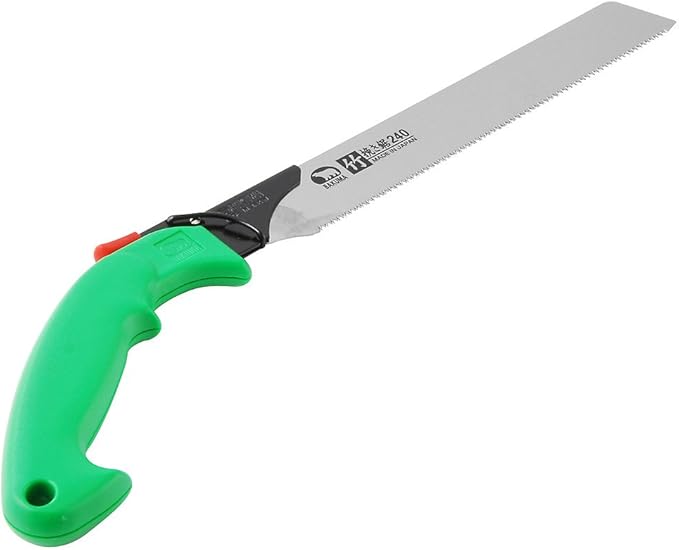
竹鋸(たけのこぎり)– Bamboo saw
A saw designed specifically for bamboo. The tooth shape allows clean cuts without crushing the fibers, which is important when bamboo is used for visible structures such as fences or edging. A normal wood saw will not do!

竹割包丁(たけわりぼうちょう)– Bamboo splitting knife
Used to split bamboo evenly when preparing materials for fences, screens, or garden structures. Allows controlled splitting along the grain.

クリ針(くりはり)– Bamboo fence needle
A long needle used to thread wire or cord when tying bamboo fences. Essential for woven or bound fence styles where precision and tension matter, like Kenninji-gaki.
RJG’s Amazon Picks:


All links are tied to our partner program. By ordering through them you are supporting Real Japanese Gardens and this blog!
Cleaning Tools Used in Traditional Japanese Gardens


竹箒(たけほうき)– Bamboo broom
Used for daily cleaning of paths, stepping stones, and garden surfaces. Gentle enough not to damage moss or gravel.
I always used a different kind of broom in Germany, or a rake. Now, I couldn’t live without a bamboo broom for gardening work. How can one live without a bamboo broom?
飛散防止ネット(ひさんぼうしネット)– Scatter prevention net
Green mesh sheets placed under trees during maintenance. These nets make seasonal cleaning much easier and are commonly used by us.
自立式バッグ(じりつしきバッグ)– Self-standing garden bag
Used for collecting leaves, pine needles, and garden waste during cleaning work. The bag stands on its own, which makes it practical when working alone or moving frequently between areas. Commonly used together with leaf nets during seasonal maintenance.

てみ – Garbage collector
While in Germany we used buckets for collecting weeds out of perennial plantings, in Japan we are using Temi. Usually in orange for better visibility.
Ladders Used in Traditional Japanese Gardens

三脚(さんきゃく)– Three-legged garden ladder
Designed specifically for garden work. The single back leg can be placed securely in soil or between stones, making it ideal for pruning trees on uneven ground.
RJG’s Amazon Picks:
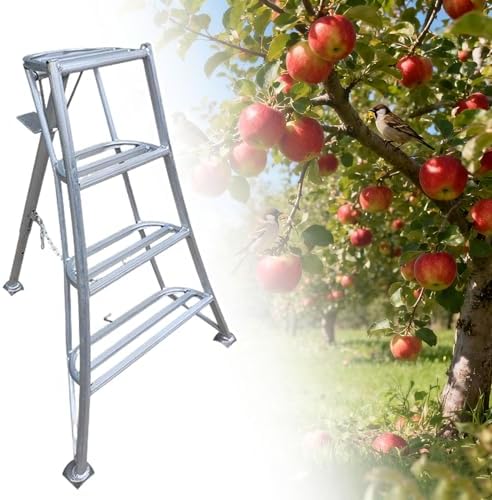
Aluminum Step Ladder with Safety Chain
Small version of what we usually use. It’s more flexible than a typical ladder.
All links are tied to our partner program. By ordering through them you are supporting Real Japanese Gardens and this blog!
As a bonus, here are a few pictures of us (me) using the tools.


With twelve years of professional landscaping experience under her belt, Anika Ogusu is your perfect guide to the world of Japanese gardens. Her love of nature began early, in the woods near her childhood home and the garden of her grandmother’s house. During her teenage years she developed a strong interest in Japanese culture, and after university she decided to combine her love of Japan and gardens into a profession. Anika started her career as chief gardener in charge of the perennial valley at the Botanical Garden in Hamburg, Germany, then moved to Tokyo in pursuit of her dream. For two years she apprenticed under local landscape designers and learned the art of Japanese garden design, construction and maintenance. Now, in partnership with Real Japanese Gardens (www.japanesegardens.jp), her wish is to spread the magic of Japanese gardens to the rest of the world. Her in-depth guide books on gardens throughout Japan are available in eBook format or paperback. In her free time, Anika enjoys exploring her adopted country (especially green moss gardens), and soaking up nature and any details that interest her.
Support our Work on Patreon

Our Patrons are making our work possible and are the first to read!
With twelve years of professional landscaping experience under her belt, Anika Ogusu is your perfect guide to the world of Japanese gardens. Her love of nature began early, in the woods near her childhood home and the garden of her grandmother’s house. During her teenage years she developed a strong interest in Japanese culture, and after university she decided to combine her love of Japan and gardens into a profession. Anika started her career as chief gardener in charge of the perennial valley at the Botanical Garden in Hamburg, Germany, then moved to Tokyo in pursuit of her dream. For two years she apprenticed under local landscape designers and learned the art of Japanese garden design, construction and maintenance. Now, in partnership with Real Japanese Gardens (www.japanesegardens.jp), her wish is to spread the magic of Japanese gardens to the rest of the world. Her in-depth guide books on gardens throughout Japan are available in eBook format or paperback. In her free time, Anika enjoys exploring her adopted country (especially green moss gardens), and soaking up nature and any details that interest her.


No Comments on “Tools for Traditional Japanese Gardens”
There are no comments yet.